



Context
Jolimoi is a social-selling platform in the beauty and wellness space. Independent Stylists build their own business through the Jolimoi app. When a new Stylist joins the network, she enters a two-month onboarding program called Quickstart, designed to help her understand the model, build confidence, and make her first sales.
I led the redesign of this program as Product Designer, working closely with two Product Managers.
Duration
2 months (launched in production: March 2025)
Problem statement
The original Quickstart was a long, static checklist: PDFs, videos, no structured progression, no step validation, no visibility into real advancement. New Stylists did not know where to start. They received no feedback on their progress and felt no sense of achievement. Some Coaches had built their own tracking tools outside the app to fill the gap. The onboarding was fragmented and failed to generate momentum toward a first sale.
Original Quickstart

Business needs
The primary goal was to increase the activation rate: the share of new Stylists making their first sale within two months. The project also needed to give Jolimoi teams and Coaches real visibility into each recruit's progression, something the previous version could not provide.
My contribution
I started with qualitative interviews across three profiles: Stylists currently in onboarding, recently onboarded Stylists, and experienced Stylists acting as Coaches. Three insights emerged: clarity reduces anxiety, progress validation sustains motivation, and small wins build confidence toward a first sale.
Rather than designing the solution alone, I co-built the new structure with Coaches to anchor it in field realities and prepare adoption from day one.
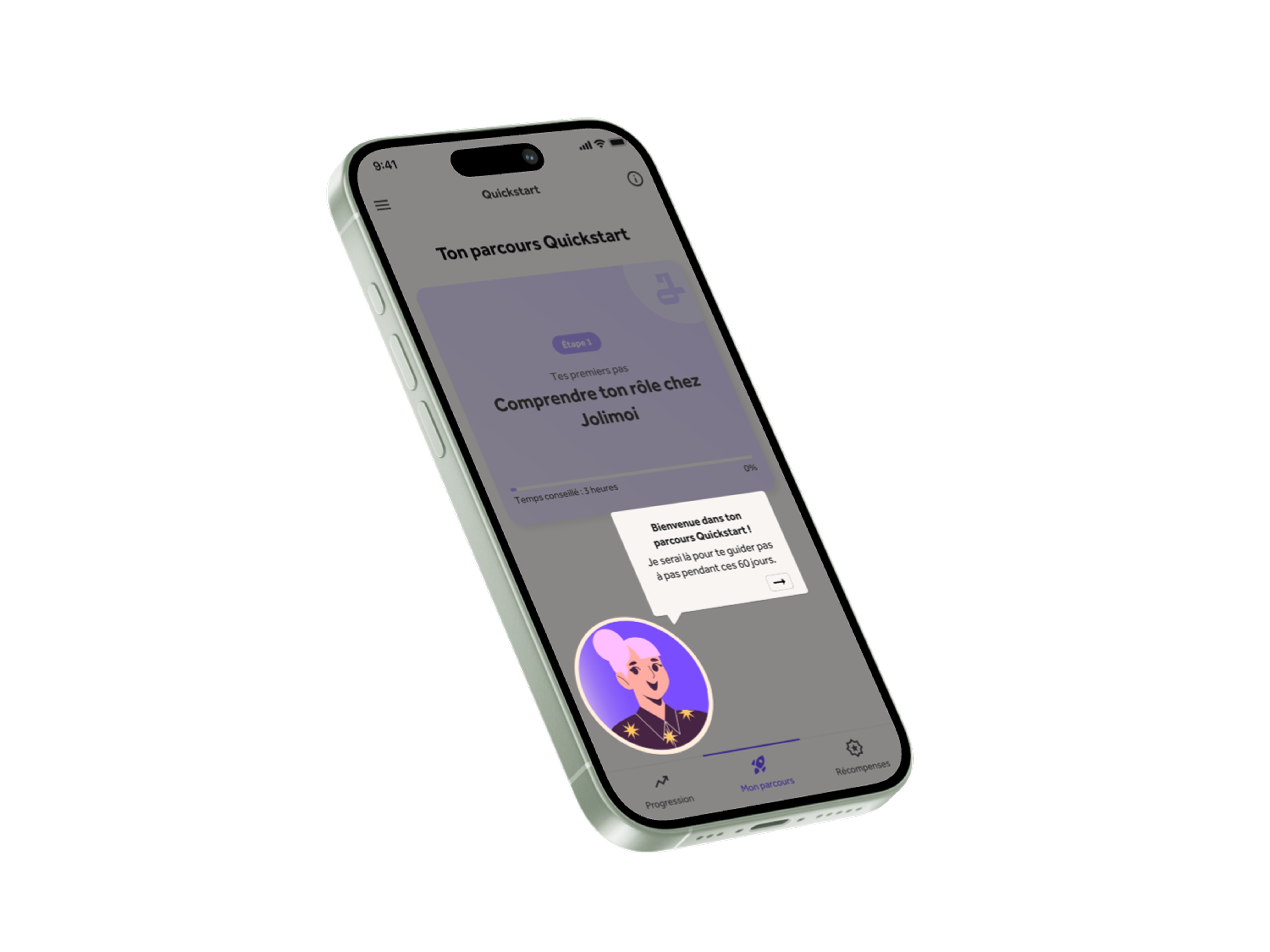
On the design side, I translated that vision into a clear, actionable flow structured in two phases and seven steps. I designed interactive in-app tutorials so Stylists could learn by practicing directly inside the tool, rather than consuming passive content.
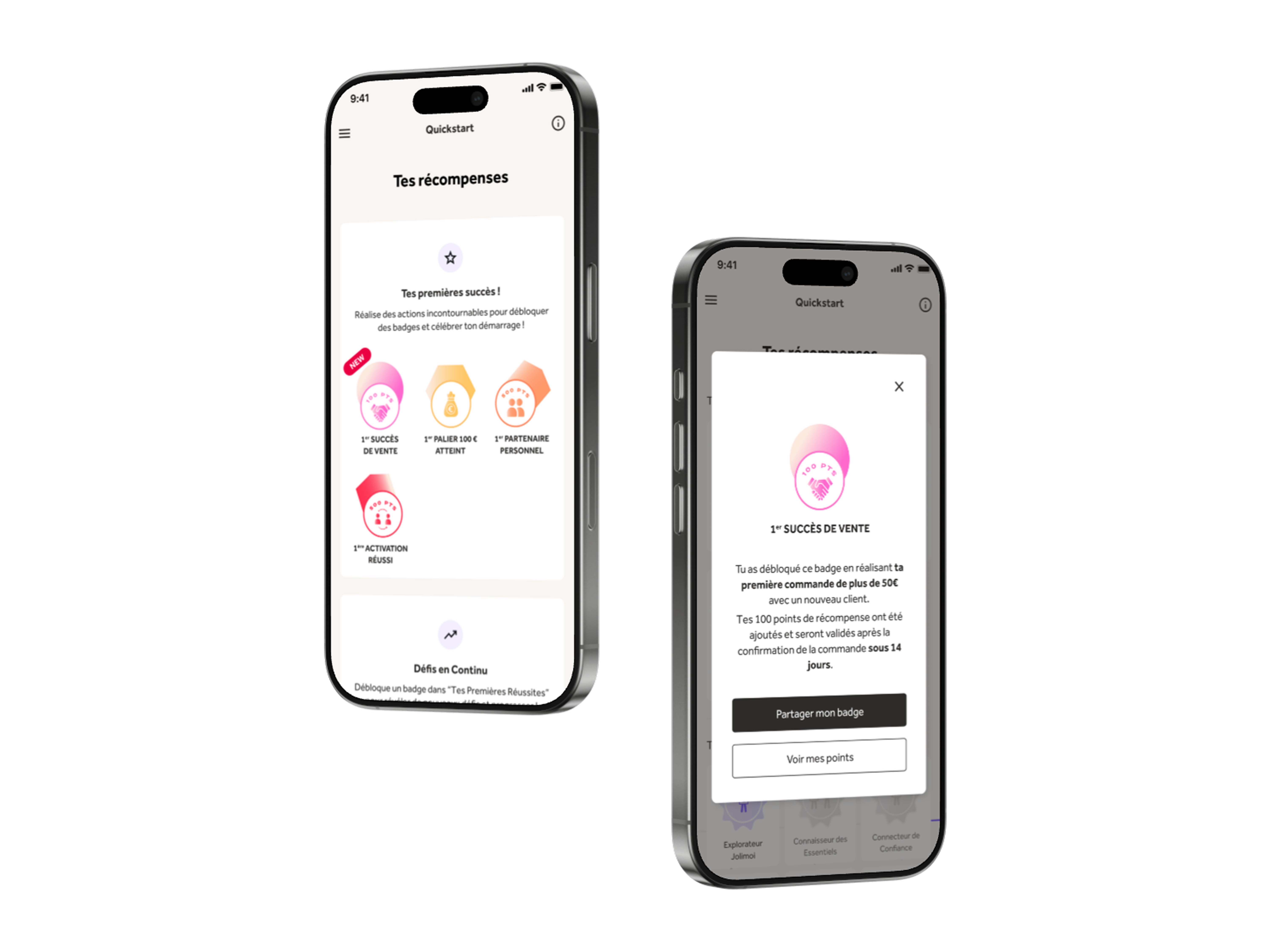
I also designed a gamification layer: a guiding avatar that introduces each step and validates progress, a badge system, and three dedicated pages covering a progression dashboard, a detailed step-by-step journey, and a rewards collection.
What I solved
The real challenge was not designing the screens. It was convincing the team that a locked, linear flow was the right answer. The default instinct was to offer flexibility. Field interviews showed the opposite: new Stylists did not want to choose, they wanted to be told what to do first. Locking progression was a deliberate design decision, not a technical constraint.
Quickstart V2
User improvements
- New Stylists describe the experience as structured, intuitive, and motivating, based on post-launch feedback.
- Interactive in-app tutorials let Stylists learn by doing directly inside the tool, replacing a system that pointed them to external videos and PDFs.
- The program was co-built with Coaches from the start. Some Coaches still run their own tracking boards in parallel, which shows that field visibility remains a strong need. A dedicated Coach view is a natural next step.
Rewards page
Business outcomes
- 9 of 11 mature months above the 35% activation goal since the March 2025 launch, with peaks at 52% in April and November.
- October fell below the goal at 28%, on a month where a free sign-up offer brought in three times the usual number of new Stylists (699 vs. ~250 on average), many with low motivation. That month is not representative of the program's normal performance.
- 430,738 views of the Quickstart V2 screen in the app since launch.
- Jolimoi teams can now track each new Stylist's progression in real time. No centralized tracking existed before.
What I'm proud of
The impact did not come from a complex feature. It came from a clearer logic: one step at a time, visible progress, a real sense of advancement. Many new Stylists felt overwhelmed before the launch. Seeing how structure alone can change confidence and drive action is what I take away most from this project.
Hindsight
Two concrete limitations remain today. The field team cannot update content without going through engineering, which creates a dependency every time the program evolves. And the journey is identical for every Stylist, whether she is a complete beginner or already active on social media. An adaptive version would let experienced profiles move faster while giving beginners a clearer path forward.